
After eighteen months of residing in the United States, John Robertson, a New Zealander, glances frequently at a map of the United States on his wall, wondering when he will get the time and resources to travel into the various metropolitan areas of the central, southern, and eastern states. Through such travel, he believes, he can gain an improved appreciation of the characteristics of the markets for fresh-cut flowers, an item that he began importing into the United States from new Zealand during his summer 'vacation' from school.
In August 1981, Robertson and his family left New Zealand for Seattle so he could study for his MBA degree at the University of Washington. A month earlier, he had resigned from his job and leased their house and small farm. On completion of the degree, the Robertsons intended to return to new Zealand, where John would seek employment in a senior management position with a company involved in exporting.
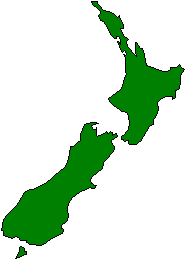
New Zealand is a country the size of Oregon with a population of 3 million. The relatively small size of its population base coupled with its distance from world markets ( see map) inhibits its ability to establish an industrial base competitive with those of the world's leading industrial countries. Therefore New Zealand depends heavily on world trade, importing fuel and manufacturing products and gaining most of its foreign exchange through exports of agricultural produce. Its fob exports average around 22 per cent of its GDP, compared with the US figure of 8 per cent, (fob stands for free on board, which includes the cost of the product to the city of export but excludes international shipping costs). To hold its place in the world economy, New Zealand lobbies hard to remove the restrictions imposed on imported agricultural products by the EU, Japan, and the United States. Along with this campaign, efforts are being made to diversify into horticultural products such as fresh flowers and fruit.

Immediately prior to leaving New Zealand, Robertson had worked for almost four years as the financial manager of a company involved in growing, wholesaling, and exporting live ornamental trees and shrubs. To sell its products on world markets, the company used agents, including two based in the United States, one in Japan, and one in Europe. The agents were paid retainers and typically provided services for several exporters. The experience gained from working for this company provided Robertson with a background in the procedures necessary for exporting. It also gave him insight into the problems that exporters face when trying to compete in foreign markets, where control over representation is hindered by distance and lack of knowledge of business procedures.
It was while working for this company that Robertson was introduced to cut-flower products. The Robertsons raised enough money to purchase a farm and then became acquainted with their neighbours, the Pratts, who were first-class horticulturalists. The Pratts had developed a new variety of the Leucadendron plant that yielded a beautiful, red leaflike flower, which the Robertsons and Pratts felt could be exported successfully.
During their first year of production, the Robertsons and Pratts formed a new entrepreneurial venture. They exported their yield through an established export company whose principal line of business was exporting fresh fruit and vegetables. The company had a large market share of this business and also had assumed a significant share of the exports of cut flowers from New Zealand. the New Zealand cut-flower export industry was small and, with the exception of trade in orchids, immature. Export companies provided the many part-time cut-flower growers with the marketing infrastructure that the themselves were unable to put together.
As the harvesting season progressed, the returns paid to the venture by the exporter declined until they reached a point at which production levels of 10,000 stems or fewer became only marginally profitable. Gary Pratt and John Robertson met with the exporter to discuss the trends. The exporter explained that price was a function of volume and that the lower prices resulted from the increased volumes of cut-flowers being placed on world markets. Export market returns were substantiated by documentation.
Pratt and Robertson were not convinced by the explanations. However, they knew little about world markets for fresh-cut flowers, and they could only speculate as to the reasons for the price movements. As there were no other established cut-flower export companies to turn to, the only way to research the matter seemed to be to do so themselves. Robertson's going to the United States for his MBA studies presented the opportunity to carry out some research there.
During his first semester of school, Robertson had little time to do research. At the end of the winter quarter of 1982, when he picked up a sample cart of Leucadendron flowers consigned by Pratt to him at Sea-Tac Airport, his ideas on how to approach the market were not yet defined. He took the flowers home and, on inspection found that they had kept well in transit and their quality was good.
In the six days remaining before school began again, Robertson decided to concentrate on researching the production and shipping costs associated with the produce, production forecasts, import procedures, the basic structure of the US cut-flower industry, and market reaction to the Leucadendron.
When he picked up the samples from the airport, Robertson had been told by airline officials that if he was going to undertake imports of invoice value greater than $250, he would have to engage the services of a customs broker. Presuming such brokers to be the experts on import procedures, he made an appointment with one. The broker was most helpful. Imported cut flowers had to be inspected by the US Department of Agriculture (USDA) on arrival. Once given clearance, duty was assessed at the rate of 8 per cent on fob value. The broker would arrange for these clearances through the USDA and the US Customs Service. The broker would charge a fee for such services. Robertson learned that this fee is fixed for shipments regardless of size but varies among broker; the broker with whom the meeting was held charged $50 per shipment. The broker also volunteered to arrange for freight forwarding companies to handle transportation to foreign markets.
As Robertson prepared his market strategy, he consulted numerous US publications that helped him get a feel for the US market. In addition, he asked Pratt to mail him a copy of a market-research publication funded by the New Zealand Export-Import Corporation that included research on the US flower market. From that publication, he learned that the major agricultural exports from New Zealand in order of importance were kiwi fruit, apples, berryfruit, processed kiwi fruit, flowers and plants, squash, frozen vegetables, onions, and other products.
Robertson finally contacted a Seattle wholesaler who was willing to place a large order for flowers, provided he was given exclusive rights to distribute the flowers in Washington State. Robertson was pleased with the reaction from the wholesaler but was aware that he had made the approach with insufficient preparation. Had he underpriced the product? Was the wholesaler's credit sound? Were exclusive rights typically given in this industry, and should he have conceded them? Was the reaction one that is normal when a new product is shown to a market? Would repeat orders be placed? In addition to these market-related issues, there were administrative and organisational issues to consider. What should be his role in the marketing chain? Should he act as an agent taking a commission or buy from Pratt and resell the product? What form of organisation should he establish?
1. What were the issues that Robertson had to consider in developing his strategy for exporting flowers from new Zealand to the United States?
2. What were the intermediaries that Robertson used, and what roles did they play?
3. What did Robertson have to worry about in terms of import procedures?
4. What roles should Robertson play in the marketing chain, and why?
[1] Adapted from J. D. Daniels & L. H. Radebaugh, International Business, 7th edition, 1995